The Clipboard Before the Lock
Sources support the broad power of emotion and immersion in escape rooms, but they say little about the lobby, waiver, and waiting room where suspense may first take shape.
 Mara Venn · October 29, 2026
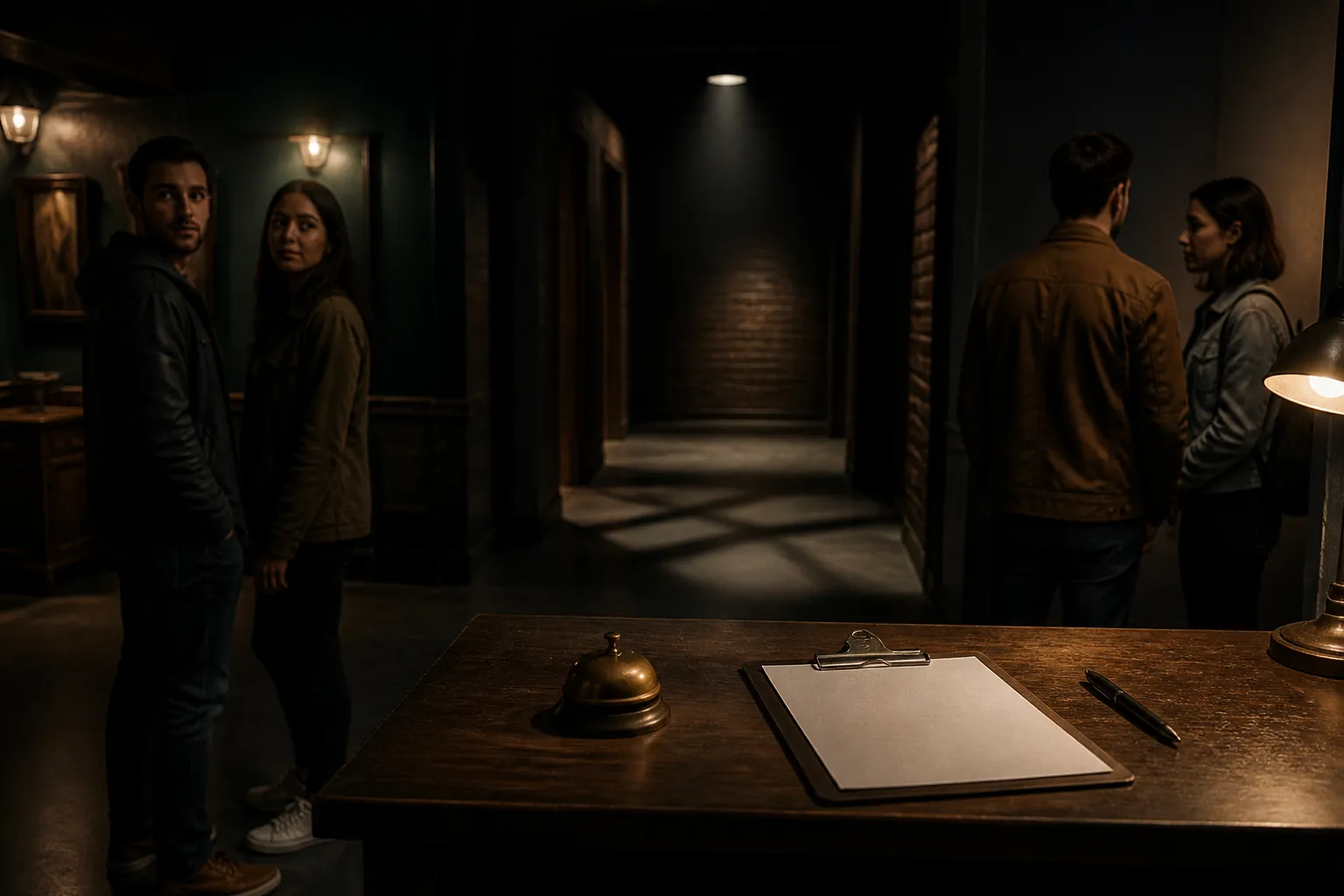
Before anyone touches a lock, the escape room has already begun making promises. There may be a booking confirmation, a front desk, a clipboard, a corridor, and a few minutes spent pretending not to study the other team. That stretch of time feels minor. It may be doing more work than the padlocks.
The available research cannot prove that lobbies, waivers, or waiting rooms are deliberately designed as suspense machines. None of the cited sources discusses those spaces directly. That gap matters. It is tempting to turn every dark hallway and stern-looking form into evidence of a master plan. Sometimes a hallway is simply a hallway, and sometimes a clipboard is a clipboard with excellent pen placement.
Still, the idea has a solid starting point. Sherlocked argues that strong escape room design begins with emotion, because players tend to remember how a room made them feel more vividly than the exact puzzle they solved. Richard Burns makes a related case for immersion and worldbuilding, noting that his favorite memories of premium rooms often have little to do with puzzles.
The threshold is part of the promise
If emotion is the lasting souvenir, then the threshold deserves attention. That does not mean every welcome desk needs a fog machine. It means the experience begins when the group starts adjusting its behavior. People lower their voices. Someone rereads the booking email. Someone else announces that they are “good at clues,” a declaration that will be remembered with tenderness later.
This is a useful design hypothesis, not a documented finding about escape room lobbies. A waiting area can create anticipation by separating ordinary time from game time. A staff introduction can establish a role. A corridor can make the next door feel important. But the research notes do not tell us how operators actually build these moments, or if they build them at all.
The distinction is especially important with waivers. A form may be practical administration, a safety measure, or part of the atmosphere, depending on how it is presented. The sources offer no evidence about liability language, safety instructions, signing rituals, or the tone of pre-game briefings. Any confident description would be borrowed from imagination rather than research.
What the evidence supports, and where it stops
The strongest supported claim is broad. Players respond to emotional design, coherent worlds, and moments in which they feel involved in the story. Sherlocked describes multisensory details, including materials that feel appropriate to the fiction, as a way to protect immersion. It also emphasizes roles, character interactions, and agency. A player feels more seen when they matter inside the story than when they are merely anonymous hands searching for a key.
That principle could extend to the minutes before entry. A guest who is addressed as a character, given a meaningful instruction, or invited into a fictional situation may begin playing before the official start. Yet “could” is doing honest work here. The cited material does not report observations of waiting rooms or compare guests who received theatrical briefings with guests who received ordinary ones.
Several potentially relevant sources were unavailable in usable form, including a Game Developer article on dramatic structure and multiple PDFs. Their contents cannot be responsibly filled in from their titles. The result is a smaller, cleaner claim: emotion and worldbuilding matter, while the precise craft of pre-game suspense remains open for direct reporting.
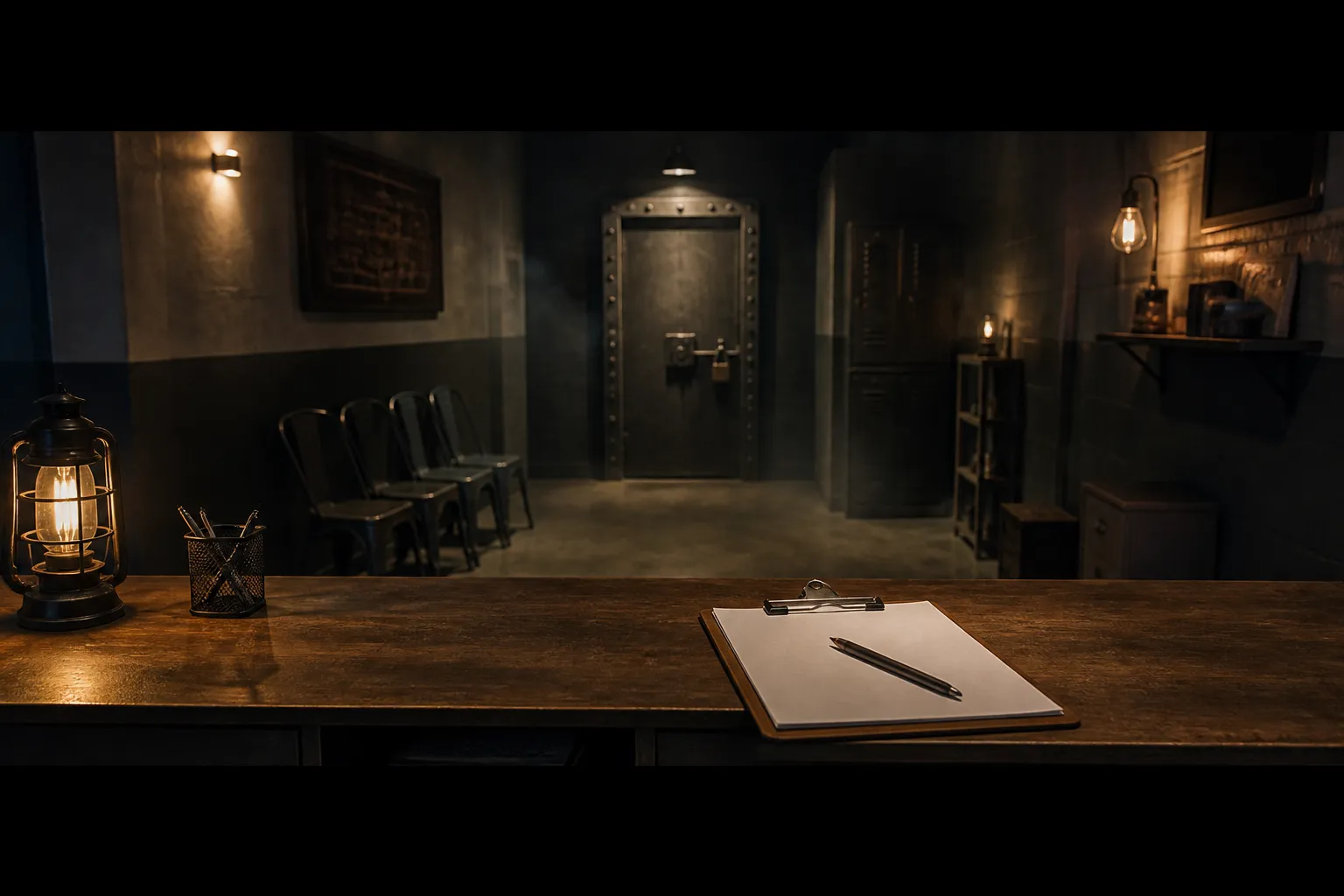
Paperwork can puncture the spell, or mark the border
Paperwork has an awkward relationship with atmosphere. It belongs to the practical world, where names must be spelled correctly and someone needs to know about a bad knee. It can also mark a boundary between the ordinary afternoon and the fictional hour ahead. The same sheet may feel like a speed bump in one venue and a ceremonial threshold in another.
We do not have source-backed evidence for which approach works better. We can, however, ask precise questions. Is the information clear? Does the process respect the player’s time? Are safety instructions understandable? Does any theatrical language add meaning, or merely decorate a routine form? These questions keep the conversation grounded. Suspense should not require guests to guess what they have agreed to.
The best pre-game ritual would probably make the player feel oriented rather than trapped. That is an inference from the sources’ shared concern with clarity. Sherlocked describes optimal frustration as a challenge with enough clarity to invite persistence. Burns also identifies vague puzzles as a weakness. A waiting room that creates confusion before the game has begun may be atmospheric, but it is not necessarily good design.
Suspense needs a fair contract
Inside the room, uncertainty is meant to be productive. Players should wonder what a symbol means, where a mechanism leads, or why a fictional character has left a brass key beside a bowl of suspiciously innocent buttons. They should not wonder whether the rules were explained, whether the price reflects the experience, or whether the puzzle is vague because the designer ran out of time.
Burns argues that premium rooms earn their distinction through immersion, technology, reveals, and characters, provided those features deliver fair value rather than functioning as expensive decoration. He also notes that escape games longer than 60 minutes remain unusual, and that added length, space, and quality actors can contribute to worldbuilding.
That gives players a practical way to judge the prelude. Does the opening prepare the story, or simply delay it? Does a staff member’s performance make the world feel larger, or make the group wait while the venue finds a key? Does the setting feel considered in small details, or does it rely on a premium-looking sign and a heroic amount of black paint?
How to inspect the outside of the room
Because the evidence is incomplete, readers should treat the lobby as a place to observe rather than a place to decode with certainty. Notice when the experience appears to begin. Listen for whether instructions are plain. Watch for a handoff from staff member to character, if one exists. Ask whether the pre-game details support the story or sit beside it like a coat rack in a haunted house.
A few questions can sharpen the visit:
- Does the room offer fair value beyond added technology, actors, or visual effects?
- Are the immersive elements substantive, or do they mainly advertise expense?
- Are the instructions and puzzles clear enough to invite persistence?
- Does the first interaction give players agency, or only tell them where to stand?
- Does the atmosphere survive contact with practical information?
These are not a scoring system for a lobby. They are a defense against being dazzled by a door. The industry is still uneven, with rooms of very different quality sometimes presented at similar prices and ratings. A polished waiting area may signal care. It may also be a polished waiting area. The room itself has to follow through.
The moment before the timer
The most compelling possibility is that suspense begins when players stop acting like customers and start acting like people inside a situation. Sherlocked describes that shift as a memorable point in the experience. A thoughtful opening might encourage it before the first puzzle, through a role, an instruction, a voice, or a detail that gives the group a reason to pay attention.
But the available sources leave the lobby, waiver, and waiting room at the edge of the map. That is useful knowledge, not an inconvenience to hide. It tells us where future reporting should go: observe the handoff, read the instructions, interview operators, and ask players what they remember before the door closed. Until then, the pre-game ritual remains a promising theory with a clipboard in its hand.
Sources
- Defining "Premium Escape Rooms" & Why It Matters - Room Escape Artist
- Applying Dramatic Structure to Escape Room Game Narratives
- https://scottnicholson.com/pubs/stateofescape.pdf
- https://scottnicholson.com/pubs/askwhy.pdf
- https://www.laerdal.com/cdn-4a5dc2/globalassets/documents/19-17990---simulation-escape-room-ebook_final2.pdf
- Immersive Escape Room Design: Designing for Emotion | Sherlocked
- https://cdn.clinicaltrials.gov/large-docs/67/NCT07179367/Prot_SAP_000.pdf
- https://cdn.clinicaltrials.gov/large-docs/99/NCT07204899/Prot_SAP_001.pdf